20 Cozy Japandi Winter Decor Ideas Without Visual Clutter
You want to come home on a dark winter evening and feel your shoulders drop. Soft light, a warm wool throw, a cup of tea, and a room that feels quiet instead of busy.
The catch is that most winter decorating adds stuff. More pillows, more candles, more little seasonal pieces on every shelf. The room gets warmer, but it also gets louder, and by January it can feel like you live inside a storage bin.
Japandi style solves that tension. It borrows the calm, spare lines of Japanese design and the cozy comfort of Scandinavian homes, then meets in the middle. Warmth comes from texture, wood, and light, not from piling things up.
These Japandi winter decor ideas cover the living room, bedroom, entry, and small spaces. Most are simple swaps you can make in an afternoon, and many cost little or nothing because they start with editing what you already own.
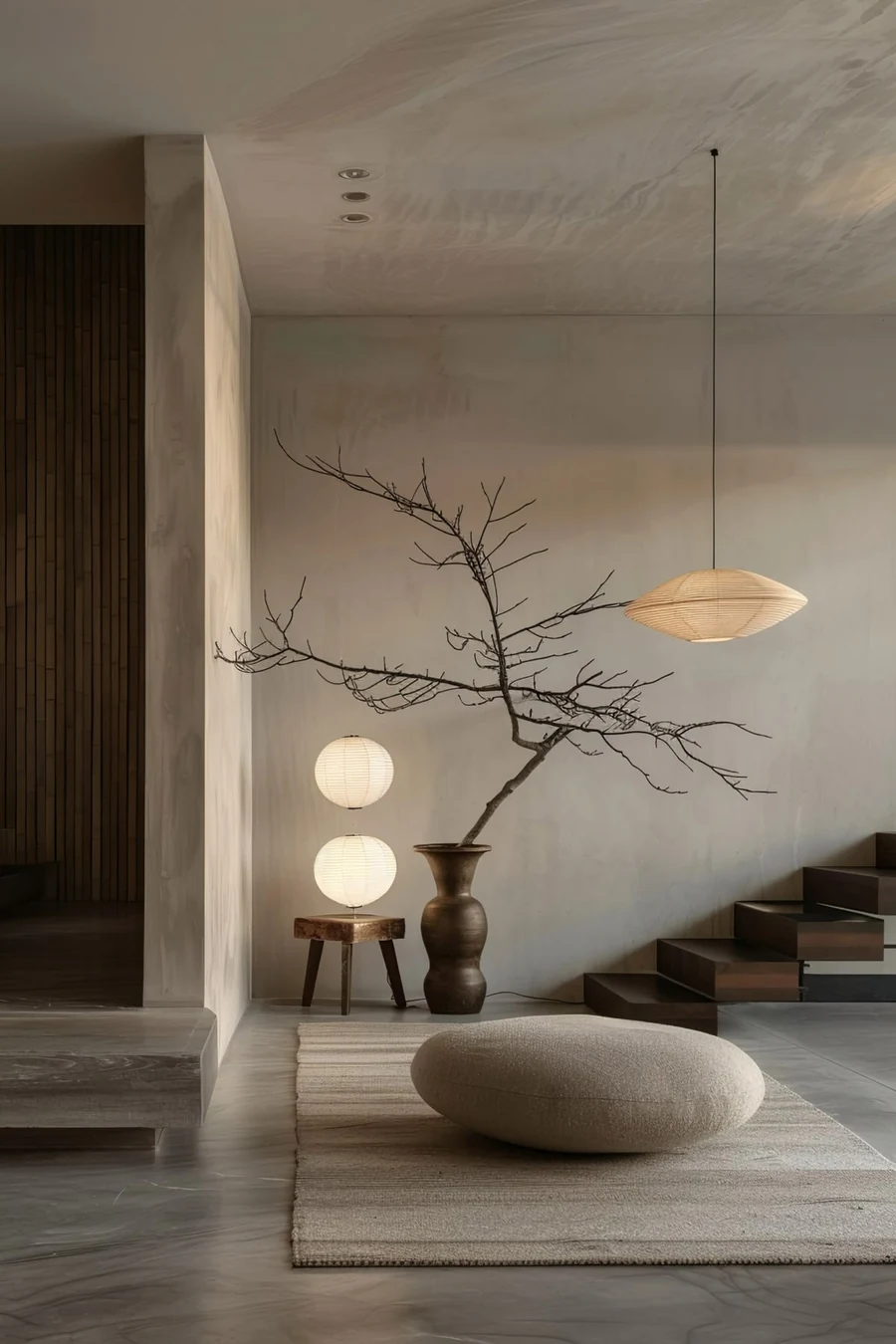
1. Swap Bright Overhead Light for a Low Paper Lantern Glow
Source: Pinterest QuietMinimal
Winter evenings start early, and a single ceiling light makes a room feel flat and a little cold.
Japandi rooms get their warmth from low, scattered light. Move the glow down to where you actually sit:
- A paper lantern floor lamp beside the sofa
- A small ceramic table lamp on a side table
- A rice paper pendant hung low over the dining table
Use warm bulbs marked 2700K or lower. Cool white bulbs make wood look grey and linen look tired.
Turn the overhead light off after sunset for one week. Most people never switch it back on.
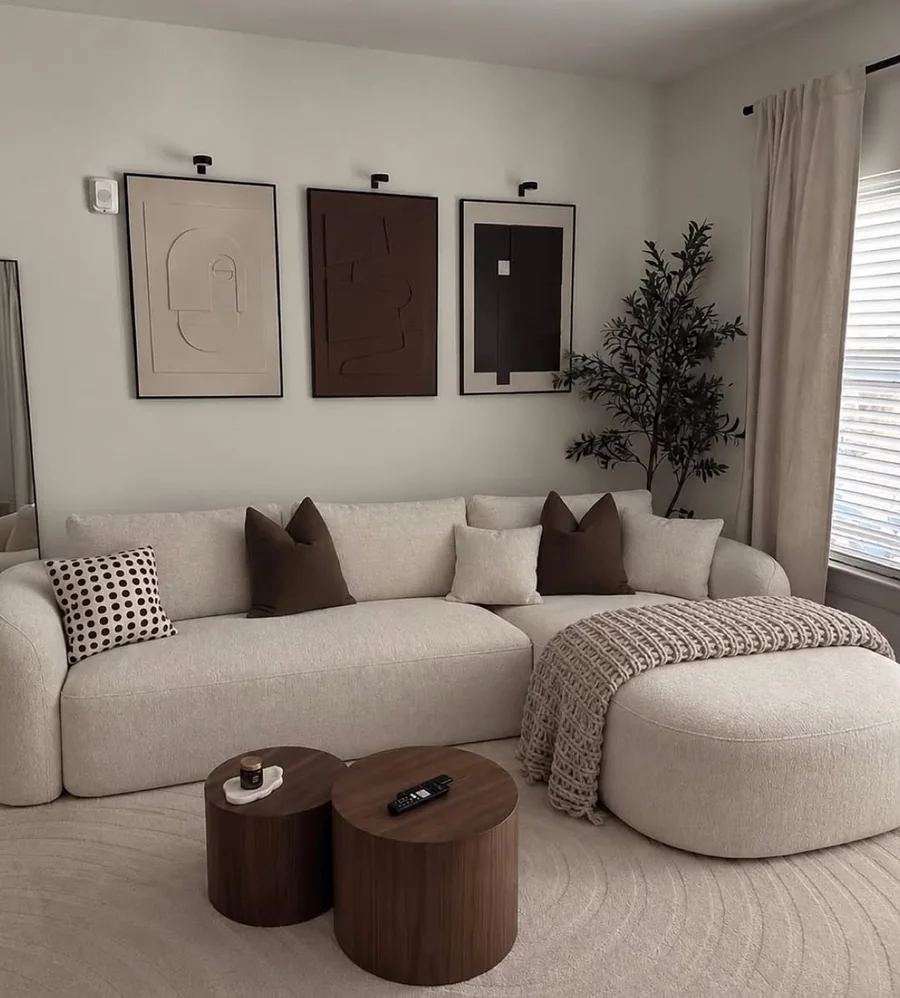
2. Drape One Chunky Wool Throw Instead of a Pile
Source: Instagram @interiorbyona
The usual winter instinct is to add a blanket to every chair. Three throws on one sofa start to look like laundry day.
Pick one large throw in wool or a wool blend, in oatmeal, warm grey, or soft clay. Fold it in thirds lengthwise and lay it over one arm of the sofa, letting the end fall loosely toward the floor.
That single fold gives the eye one soft spot to rest on. The rest of the sofa stays clean and simple.
Keep a second throw in a lidded basket nearby for guests, out of sight until someone gets cold.
💡 Quick Tip
Open loop chunky knits snag easily on rough wood and cane. If your sofa sits next to a slatted side table, choose a tightly woven wool throw instead.
3. Mix Linen, Boucle, and Wool on the Sofa Cushions

Source: Instagram @learn.california
Here’s a simple rule for Japandi cushions: same color family, different textures.
Keep it to three or four cushions in total. Choose covers in quiet shades like cream, sand, and charcoal, and let each one feel different under your hand. A nubby boucle beside a crisp linen does more than any pattern could.
In winter, swap thin cotton covers for heavier fabrics. You keep the same inserts and only buy covers, which keeps the cost low and storage easy.
Skip anything shiny. Satin and metallic thread fight with the matte, natural feel of the room.
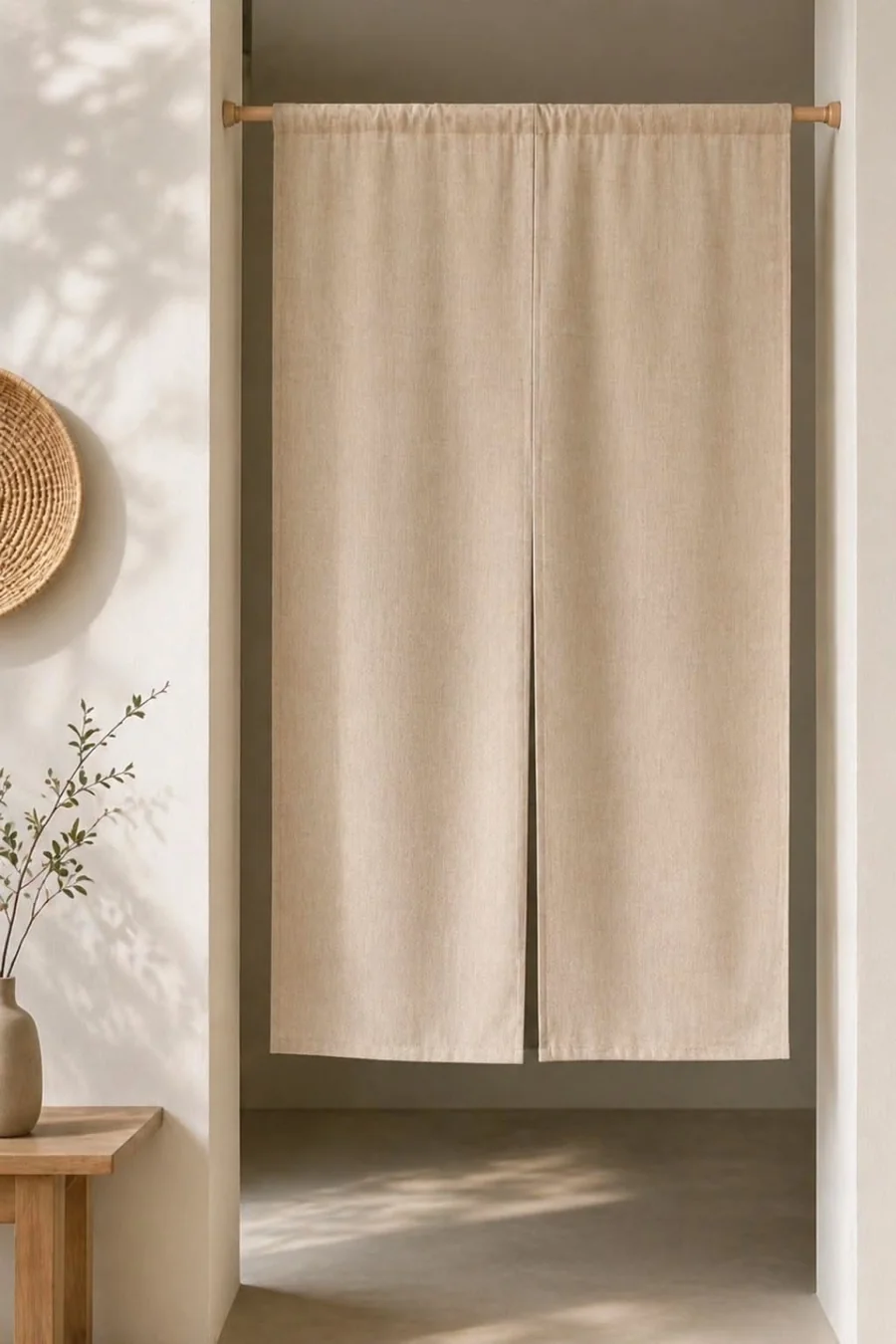
4. Hang a Linen Noren Curtain in a Doorway
Source: Pinterest @farmabilia
Look down a hallway at dusk and you’ll often see straight into the laundry pile or the kitchen counter. A noren fixes that view.
A noren is a split fabric panel that hangs in Japanese doorways. It softens a hard opening, hides the mess behind it, and still lets people walk through without opening a door.
Choose plain linen or cotton in undyed cream, oatmeal, or soft indigo. Hang it so the bottom sits around chest height, which keeps the doorway feeling open.
In winter it also slows a little of the drafty air moving between rooms.
Measure the inside width of the door frame.
Buy a tension rod in that width, so you need no screws or holes.
Slide the noren onto the rod and twist it into place near the top of the frame.
Check that the hem hangs around chest height, then nudge the rod up or down.
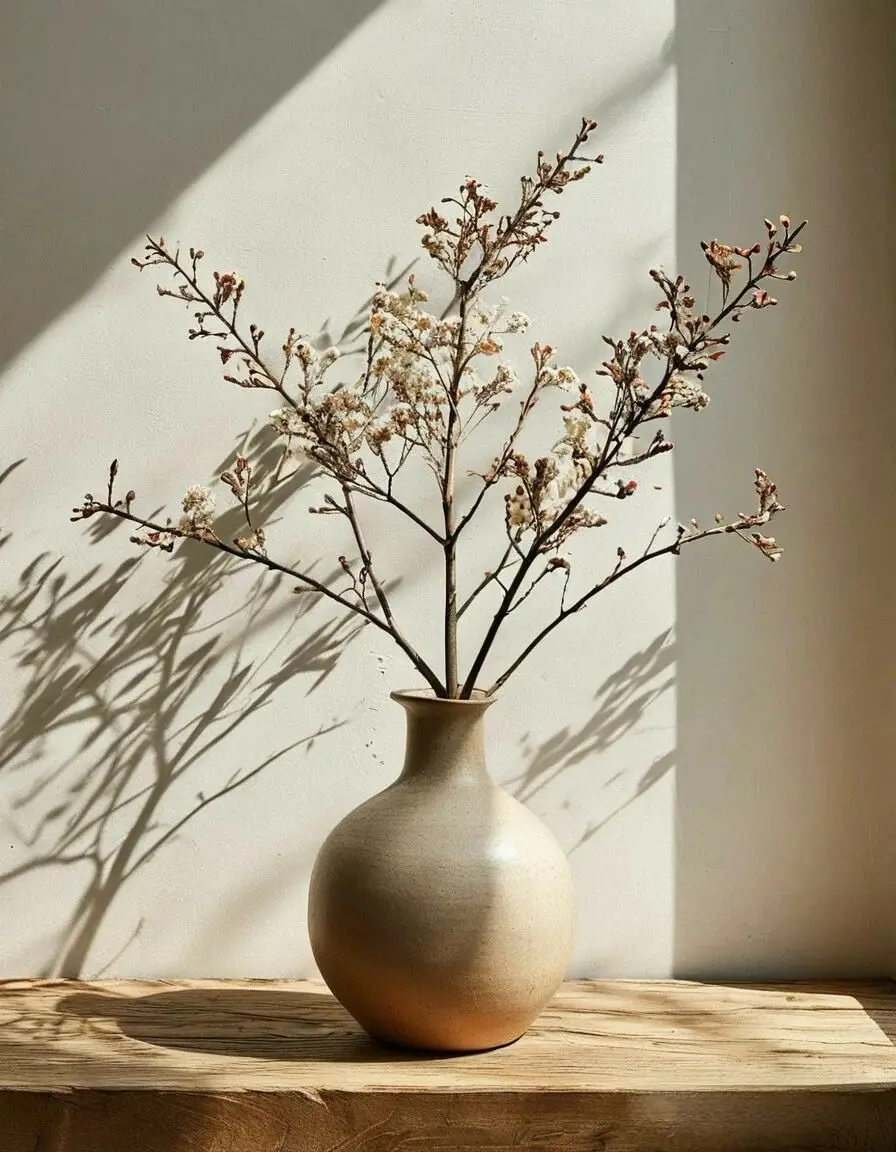
5. Put Bare Winter Branches in One Stoneware Vase
Source: Pinterest puh17_84
A few dark, twisting branches in a rough stoneware vase. Lots of empty wall behind them. That’s the whole arrangement, and it looks better than a crowded centerpiece.
Cut or buy three to five branches with interesting shapes. Cherry, birch, willow, and dogwood all work, and fallen branches from a walk cost nothing. Trim them to different heights so the tallest is about twice the height of the vase.
Place the vase off center on a console or sideboard.
Keep the vase heavy and wide at the base. Tall branches tip a light vase with the first bump.
Choose a matte vase in clay, charcoal, or cream.
Let some branches lean outward instead of standing straight up.
Leave a wide gap of bare wall around it.
Fake snow, glitter, or ornaments hung on the branches.
So many stems that the shapes disappear.
Clear glass that shows messy cut ends.
6. Give the Coffee Table One Tray and Three Objects

Source: Pinterest
Clear the coffee table completely first, including the remotes, the mail, and this morning’s mug.
Then set down one wooden or stone tray and add only three things. Odd numbers feel relaxed, and three is enough to look intentional without crowding.
Everything else goes somewhere with a lid or a drawer. Remotes live in a small box, and the books you’re reading stack on the shelf below.
When a fourth thing creeps onto the tray, something has to leave. That one habit keeps the table calm all winter.
A good three object mix
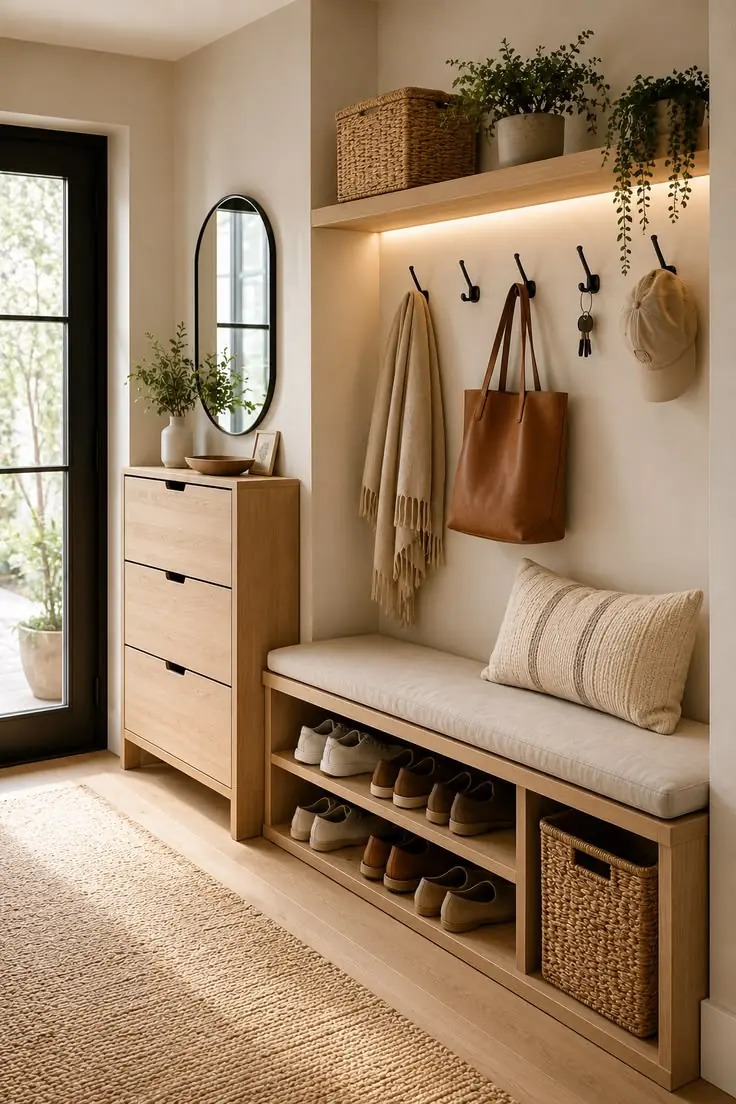
7. Create a Calm Genkan Style Shoe Zone at the Door
Source: Pinterest
A clear entry sets the tone for the whole house, and in winter it’s usually the messiest spot.
Japanese homes have a genkan, a small area just inside the door where shoes come off before anyone steps further in. You can borrow the idea in any home:
- Lay a dark, washable mat to mark the shoe zone
- Add a low wooden bench or a shoe cabinet with a closed front
- Hang two or three wooden pegs for coats and bags
Keep only this week’s shoes out. Everything else goes in a closet.
Wet snow and salt stay at the door, which means less cleaning everywhere else.
Boots in a heap by the door, salty puddles on the floor, and coats draped over the nearest chair.
Shoes lined up on a slatted wood rack, coats on pegs, and a clear path into the living room.
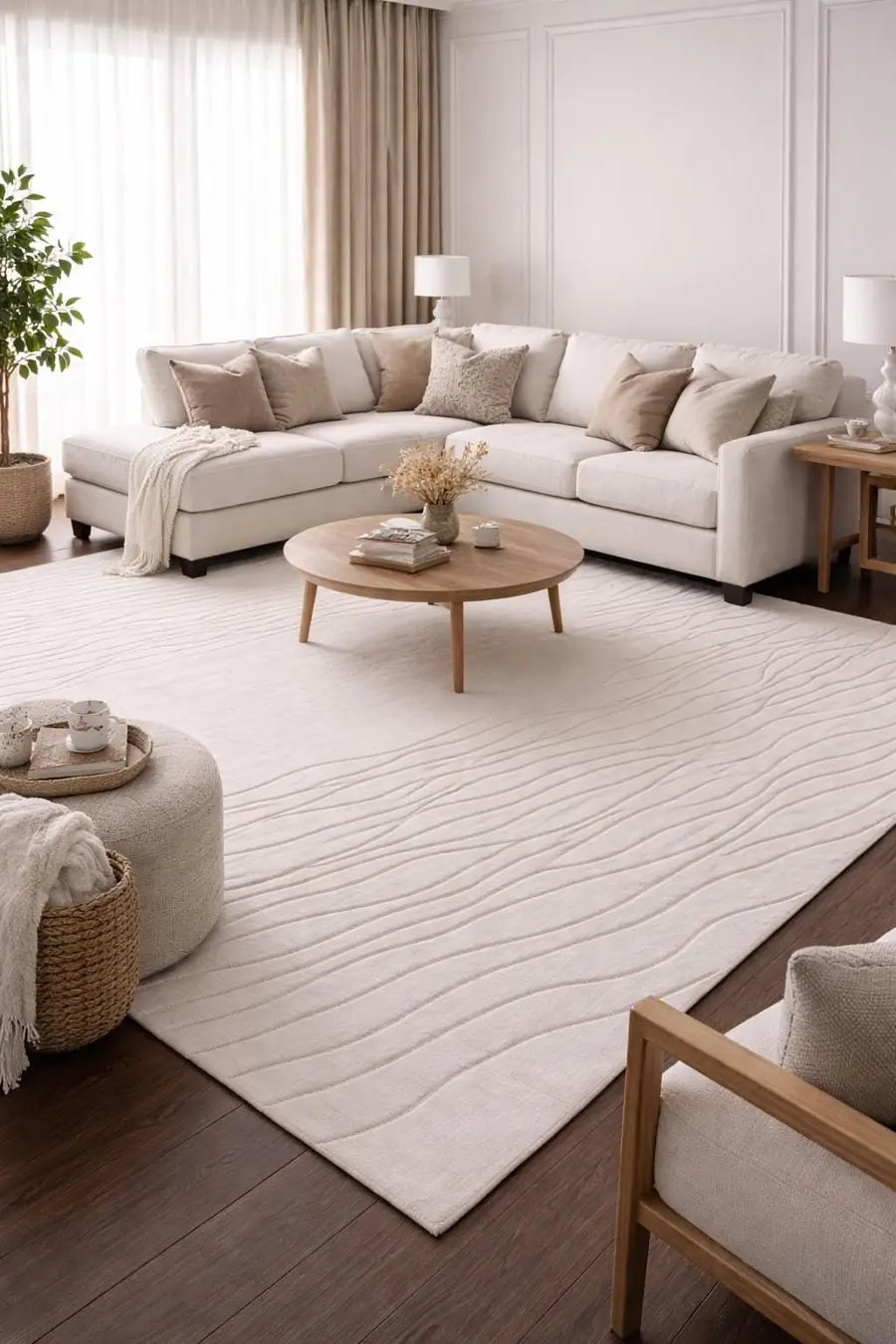
8. Lay a Low Wool Rug to Warm Cold Floors
Source: Pinterest
Wool or jute? Both look natural, but they feel very different under bare winter feet.
Wool is warmer and softer, so it suits spots where you sit on the floor or walk around in socks. Jute has a lovely rough look, but it feels scratchy and can be hard to clean.
Choose a low pile or flatweave rug in a solid color or a very faint pattern. Big bold designs pull attention away from the furniture and the wood.
Size it so at least the front legs of the sofa and chairs sit on it. A small rug floating in the middle makes a room look smaller.
| Wool | Jute | Cotton Flatweave | |
|---|---|---|---|
| Feel | Soft and springy | Rough and firm | Thin and smooth |
| Warmth | Warmest of the three | Cool underfoot | Light warmth |
| Cleaning | Spot clean spills quickly | Water can leave marks | Often washable, check the label |
| Good Pick If | You sit on the floor a lot | The spot gets little foot traffic | You have kids, pets, or a tight budget |
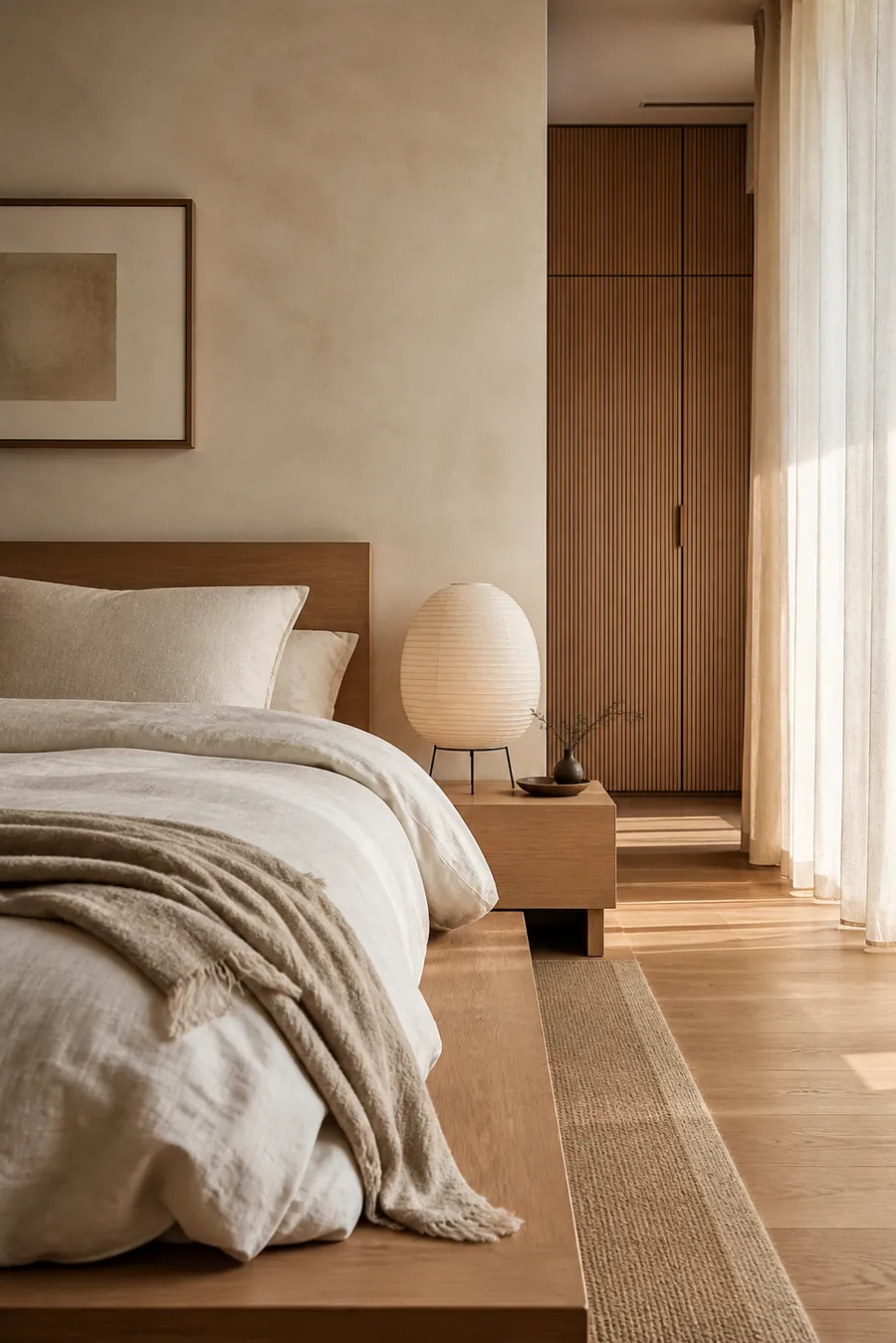
9. Dress a Low Bed in Layers of Linen and Wool
Source: Pinterest
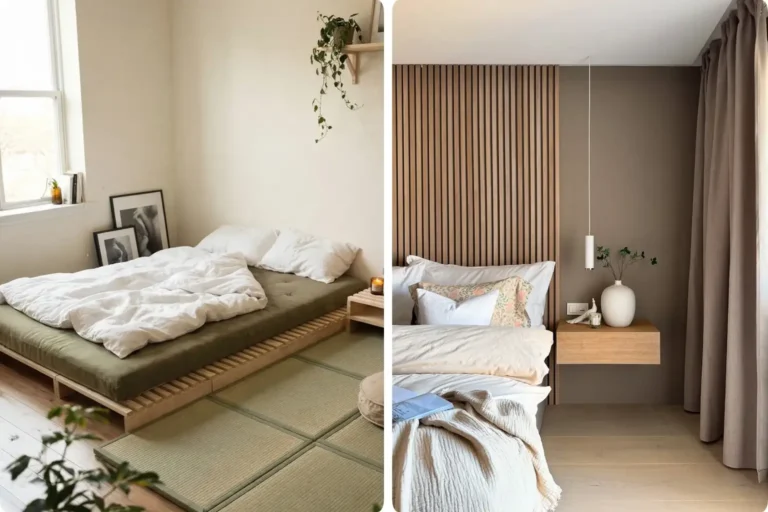
The coziest Japandi bedrooms tend to have the plainest beds. No towers of decorative pillows, no shiny quilts, just good fabric in soft layers.
Build it from the bottom up:
- Washed linen sheets in white, sand, or pale grey
- A medium weight duvet in a linen cover, left a little rumpled
- A wool blanket folded across the bottom third of the bed
- Two sleeping pillows and one long lumbar pillow, nothing more
Stick to two or three colors on the whole bed.
If your bed frame sits high, a low wooden bench at the foot brings the eye back down.
Warmth on a Japandi bed comes from weight and texture, not more pillows. If you can’t sit on the edge without moving something first, there’s too much on it.
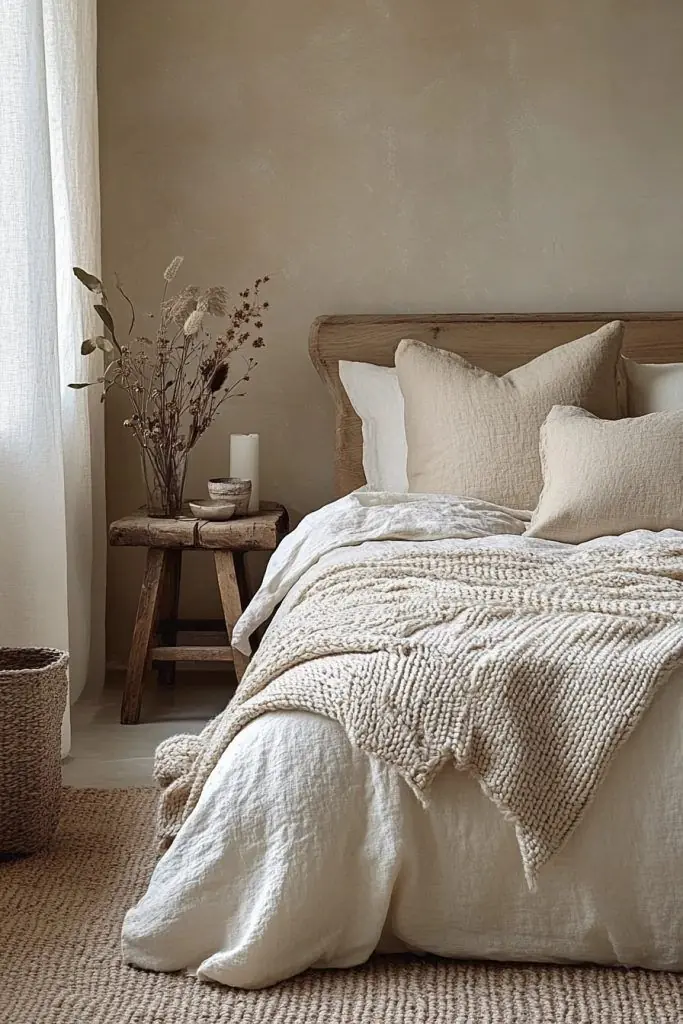
10. Use a Wooden Stool as a Simple Nightstand
Source: Pinterest
A nightstand doesn’t need drawers. In fact, drawers are often where bedroom clutter goes to hide.
A plain wooden stool beside the bed takes up less room, looks lighter, and only holds what you truly use at night. Look for oak, ash, or a dark stained wood with simple legs. Secondhand shops often have good ones for very little.
Keep the top to a short list, and slide a small lidded box underneath for chargers and lip balm.
It works especially well in small bedrooms, where a full nightstand blocks the walkway.
- What earns a spot on the stool
- ▸A small lamp with a fabric or paper shade
- ▸The one book you’re reading right now
- ▸A ceramic cup for water
- ▸A single sprig of greenery in a bud vase
11. Pick a Winter Palette of Three Earthy Neutrals
Source: Pinterest @elanhabitat
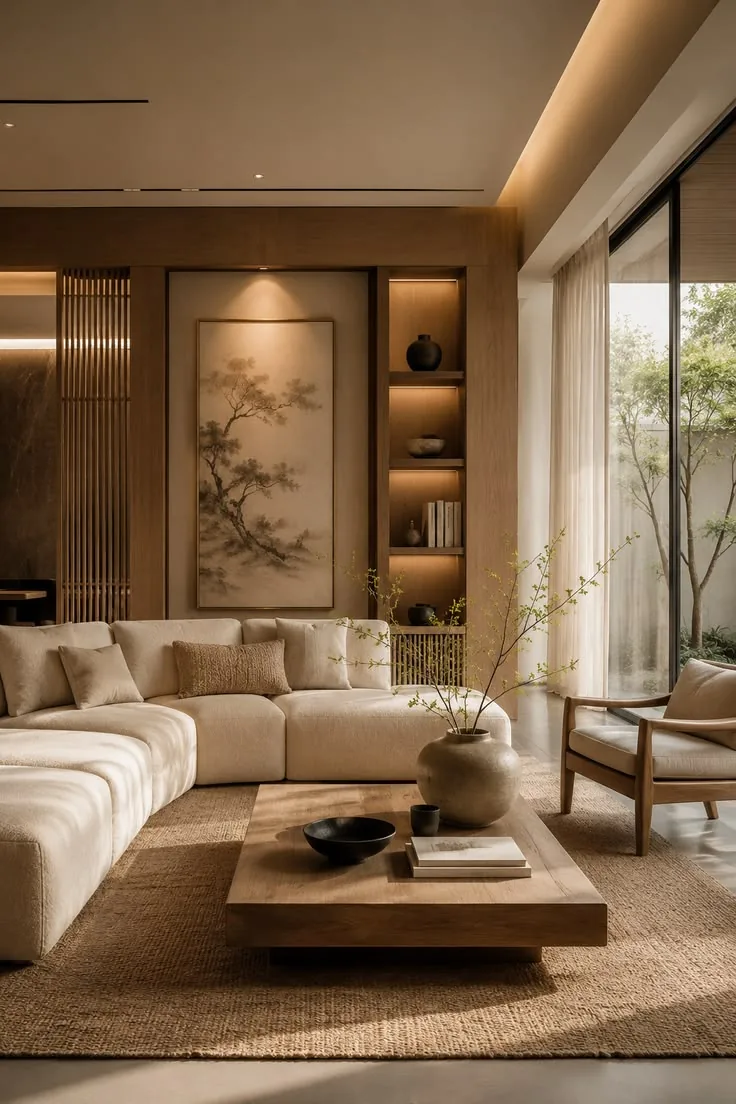
Three colors repeated around a room will calm a space faster than any new piece of furniture.
For winter, shift a little warmer and deeper than you might in summer. Pick one light base, one middle tone, and one dark anchor. Then repeat each one at least twice, in a cushion, a vase, a throw, or a frame.
This makes shopping easier too. If a new piece isn’t in your three colors, it doesn’t come home.
Wood counts as its own neutral, so you don’t need to match it to the palette.
🎨 A Warm Japandi Winter Palette
12. Group Unscented Candles on a Stone Tile
Source: Pinterest
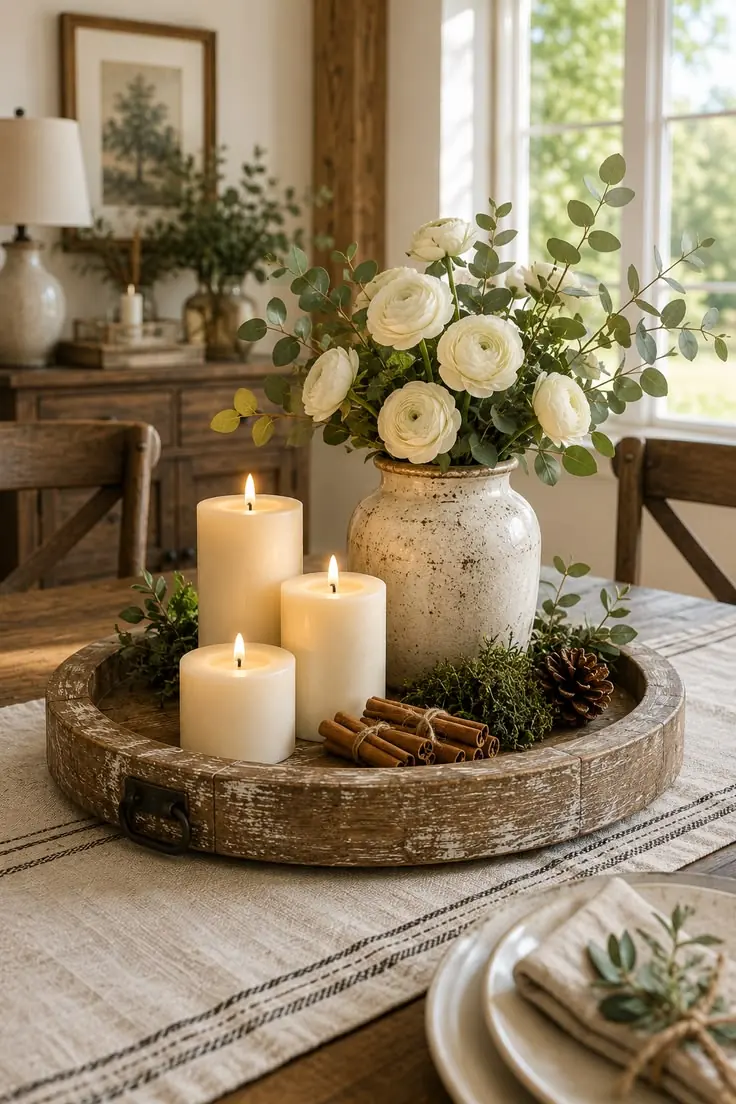
Scattered candles look busy. Grouped candles look like one quiet pool of light.
Set three pillar candles of different heights on a flat stone tile, a slate offcut, or a small wooden board. The base gathers them together and catches any drips. Choose ivory or natural beeswax, and skip printed jars with big labels.
Unscented candles keep things simple, especially if you also have fresh greenery or a diffuser nearby.
A single stone tile from a hardware store costs very little and does the same job as a fancy tray.
⚠️ Watch Out
Keep live flames well away from dried branches, paper lanterns, and linen curtains, and never leave them burning in an empty room. On shelves and in bedrooms, flameless pillar candles with a timer give a similar glow without the worry.
13. Choose One Large Plant Over Many Small Ones

Source: Pinterest
A windowsill lined with six small pots looks busy, and in winter half of them usually start to droop.
One bigger plant does more. A tall snake plant, a ZZ plant, or a rubber plant gives the room height and one strong, simple shape. Set it in a plain clay or stoneware pot in the brightest corner you have.
Ask your local garden center which plants handle dry indoor heat and low winter light in your home. If you have pets, check that the plant is pet safe before you buy.
Move any small pots you keep onto one tray, so they read as a single group.
Six small pots crowding the windowsill, a few yellow leaves, and soil marks on the paint.
One tall plant in a matte clay pot in the corner, and a clear windowsill letting in every bit of winter sun.
14. Do a Ten Minute Evening Reset
Source: Pinterest
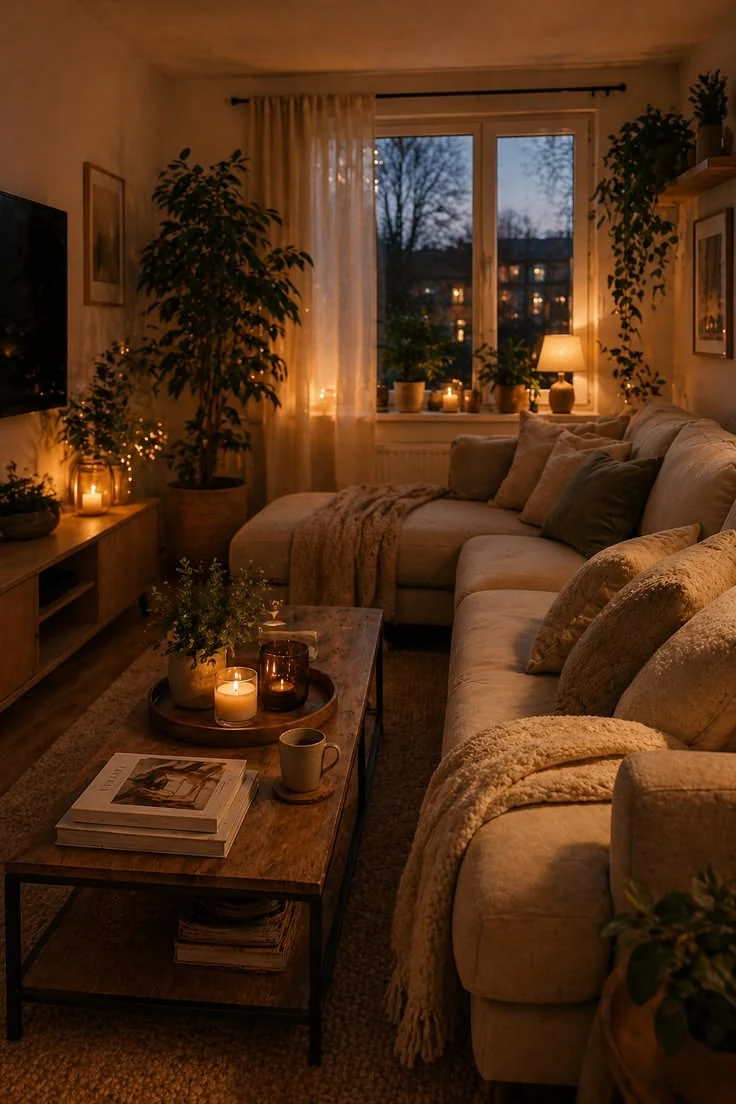
It’s 9 pm, the day is done, and the living room has quietly filled up with mugs, chargers, and a sweater on the arm of the chair.
Japandi style only stays calm when things go back to their places. The easiest way to manage that is a short reset every night, not a big clean on the weekend.
Set a timer so it never turns into a chore. Ten minutes usually covers one or two rooms.
Waking up to a clear room on a dark winter morning makes it worth it.
Carry every cup and plate back to the kitchen.
Fold the throw and lay it back over the sofa arm.
Drop remotes, chargers, and mail into their lidded box.
Plump the cushions and straighten the rug.
Switch off everything except one low lamp.
15. Hang One Calm Piece of Art on a Large Wall

Source: Pinterest
Bare walls can feel cold in winter, but a gallery wall of ten frames undoes everything else in a Japandi room.
The answer sits in between. Choose one piece and give it room to breathe. Hang it so its center sits at about eye level, with bare wall on both sides.
Look for art with soft tones and lots of open space inside the frame. A simple ink print, a pressed leaf, or a woven textile all suit the style.
Free printable art works well too. Print it on matte paper and frame it in plain oak.
16. Mix Wood Tones That Share the Same Undertone
Source: Pinterest
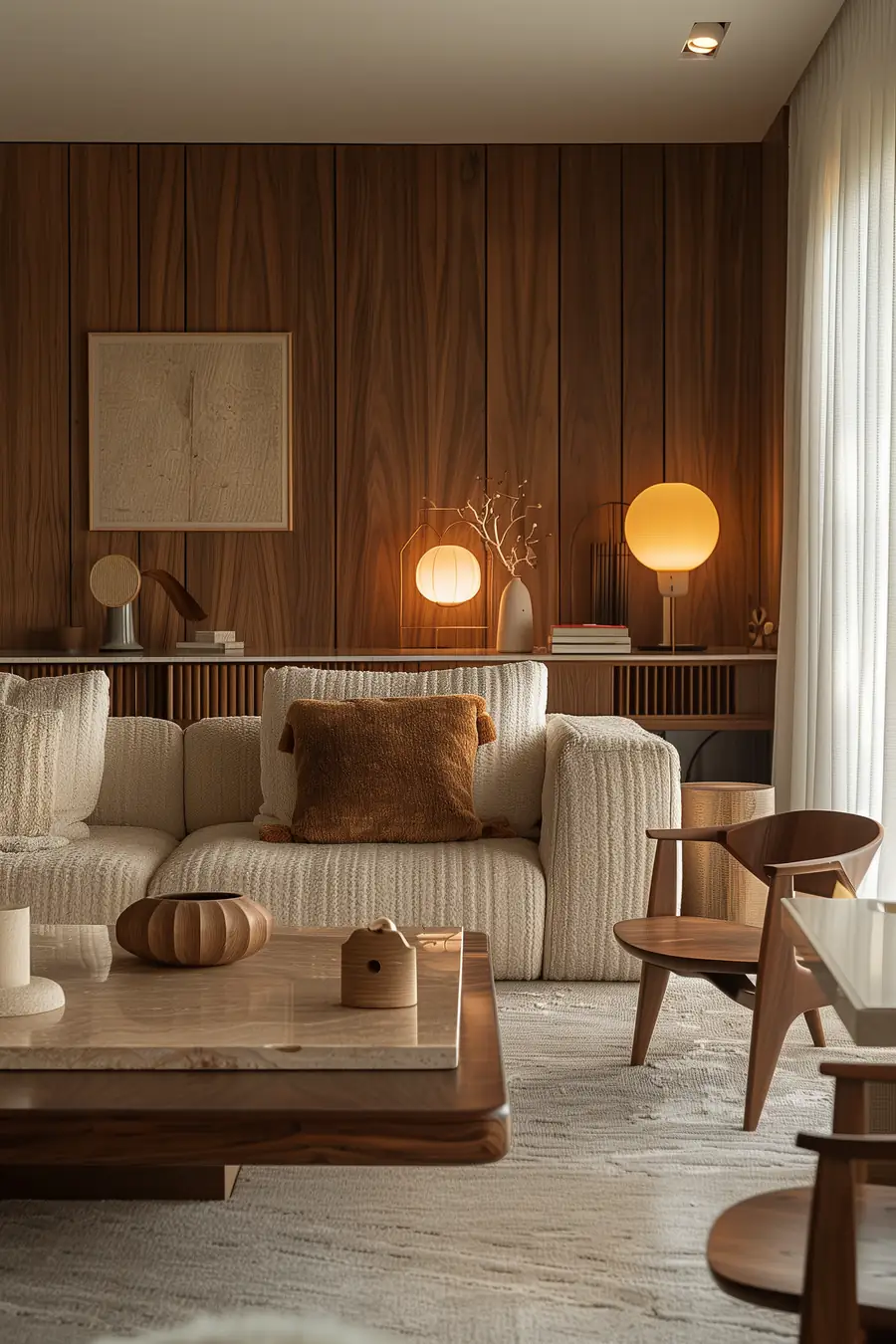
Light oak and dark walnut can live in the same room. The trick is checking the undertone, not the shade.
Hold two pieces side by side in daylight. If both lean warm, with a yellow, orange, or red cast, they’ll get along. If one leans warm and the other leans grey or pink, they’ll clash even when the colors look close.
Pick one main wood for the big pieces, like the floor, table, or bed frame. Then add a second wood in small amounts, such as a tray, a stool, or picture frames.
Two woods per room is plenty. Three is the limit.
| Light Woods | Dark Woods | |
|---|---|---|
| Examples | Oak, ash, birch | Walnut, smoked oak, dark stained pine |
| Feel | Bright and open | Grounded and warm |
| Use It For | Big pieces in small or dim rooms | Accents, or big pieces in bright rooms |
| Winter Tip | Add one dark accent for depth | Balance with cream linen so it never feels heavy |
17. Add a Winter Scent Without Adding More Objects
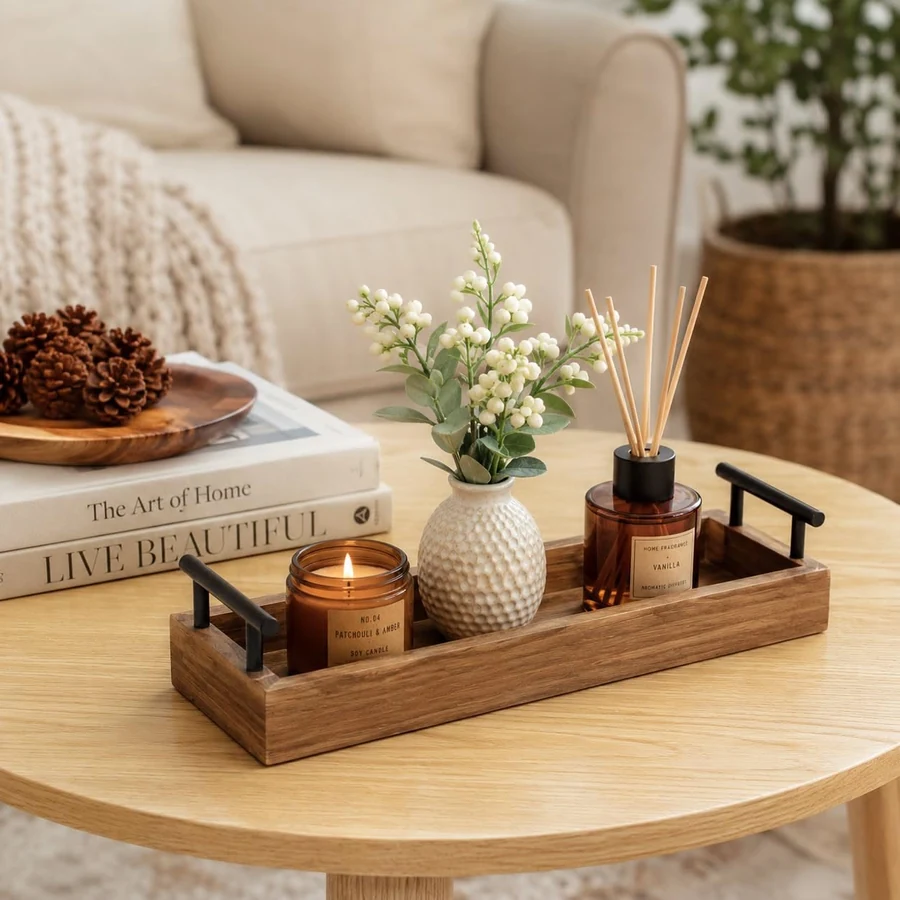
Source: Pinterest Wishna
Scent is the one kind of decor that takes up no shelf space at all.
Japandi homes lean toward clean, woody smells rather than sweet ones. Hinoki, cedar, pine, and a hint of green tea all fit the style. A small ceramic diffuser, a few drops of oil on a plain wooden block, or a pot of orange peel and cinnamon simmering on the stove will all do the job.
Choose one scent for the whole season. The house smells calm instead of mixed.
Start small. A little goes a long way in a closed winter room.
Pick one woody or green scent and stick with it.
Use a diffuser with an automatic shut off.
Open a window for a few minutes each morning.
Plug in air fresheners in every outlet.
A sweet candle, a spicy diffuser, and a floral spray in one room.
Running oil diffusers around cats or birds before asking your vet.
18. Set Up a Small Tea Corner for Slow Mornings
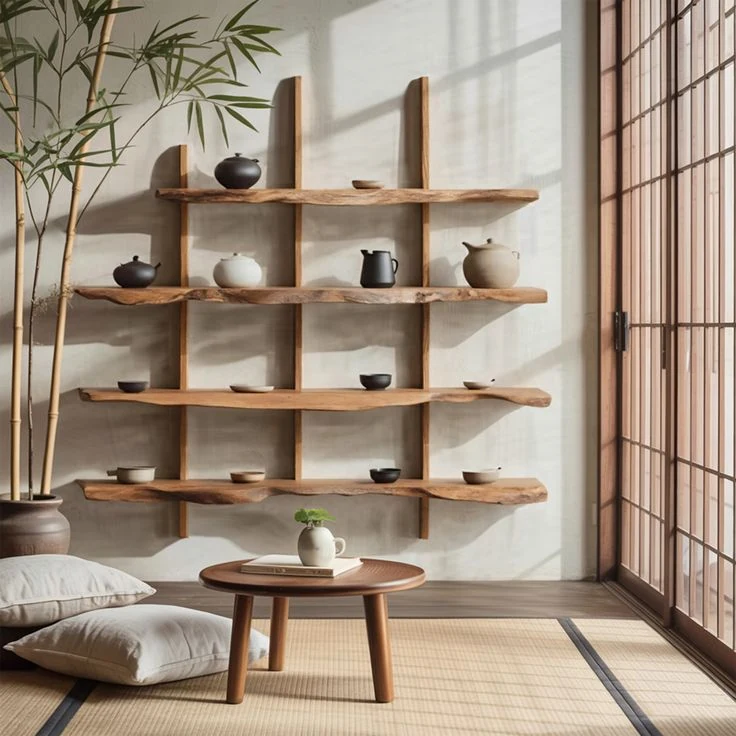
Source: Pinterest
Tea feels different when it has its own spot. A tray on the corner of the kitchen counter, or on a low shelf by the window, turns a quick drink into a short pause in the day.
Keep everything on one surface so it reads as one piece, not scattered kitchen things. Choose handmade or matte ceramics in two or three tones.
Leave only one or two teas out in the open. The rest stay in the cupboard.
If there’s room, add a floor cushion or small wooden stool nearby, and the corner becomes somewhere you actually sit.
- What goes on the tray
- ▸A small cast iron or ceramic teapot
- ▸Two simple cups, with or without handles
- ▸One lidded tin of loose tea and a wooden scoop
- ▸A folded linen cloth underneath to catch drips
19. Use a Folding Screen to Zone a Small Space
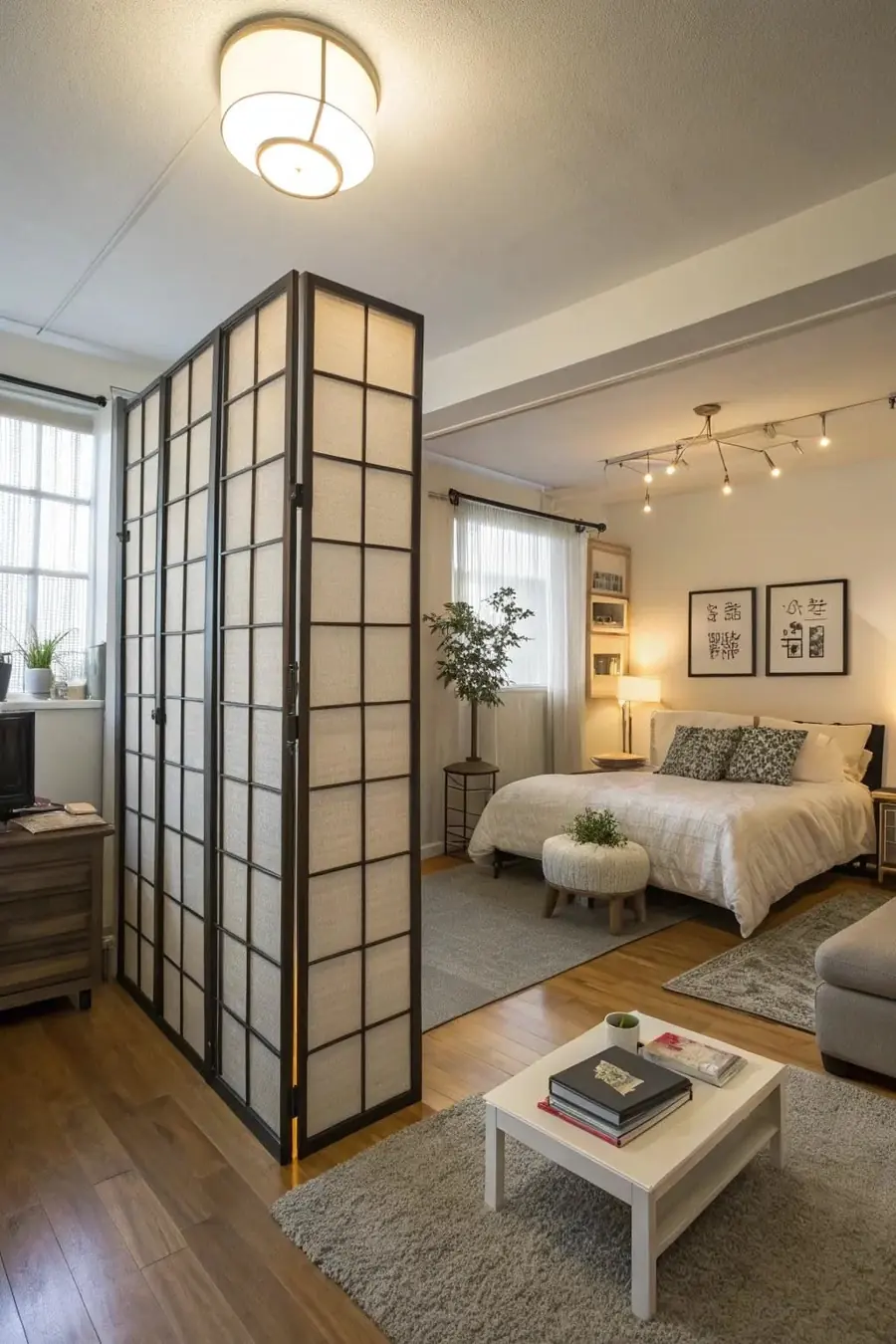
Source: Pinterest
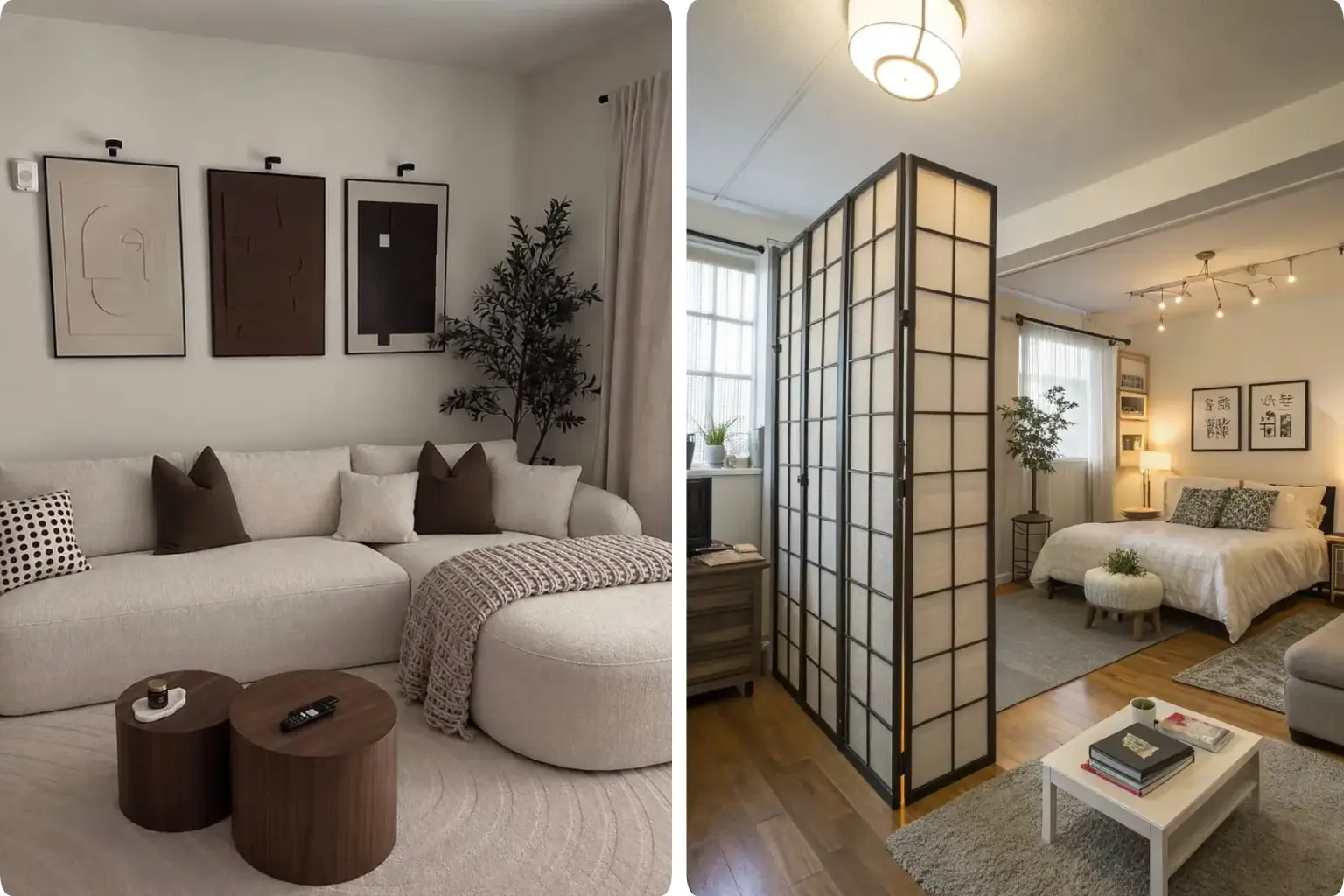
In a studio or small apartment, the bed, the desk, and the sofa often share one view. Even when it’s tidy, the room never quite feels restful.
A folding screen in wood and paper, or wood and woven cane, gives each area its own corner. Stand it between the bed and the living area, or use it to hide the desk at the end of the workday.
Paper panels let soft light pass through, so the room still feels open.
No drilling is needed, which makes it a smart pick for renters. When you need the space, fold it flat and slide it into a closet.
20. Keep a Small Winter Box and Rotate What’s Out
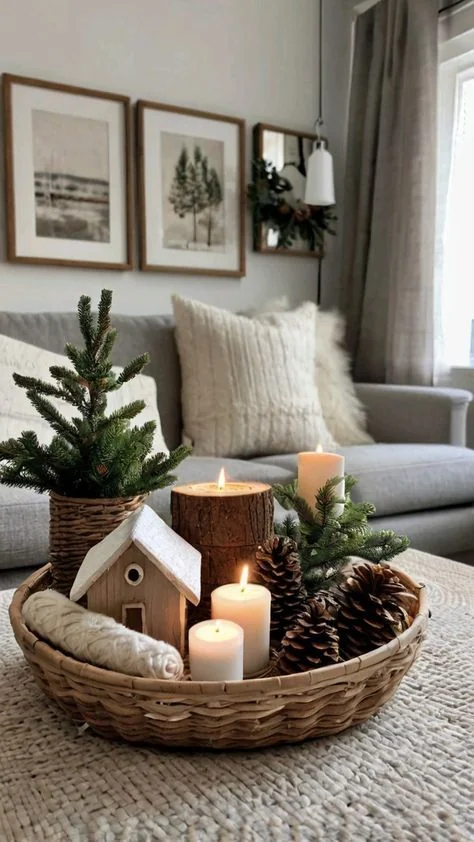
Source: Pinterest @casalonigo
Store your seasonal pieces in one box and only show two or three at a time.
Every week or so, swap one piece out and another in. A wool runner replaces a linen one on the bench. A bowl with one pinecone gives way to a single dried orange. The room feels fresh without ever looking full.
It also slows down buying. When the box is full, nothing new comes in unless something leaves.
Label the box clearly so it’s easy to find again next winter.
What to keep in your winter box
Keep It Warm, Keep It Simple
A calm winter home comes from choosing fewer things and letting light, wood, and soft fabric carry the warmth.
Start with one room, or even one surface. Clear it, add one warm texture, and switch on a low lamp at dusk. You’ll feel the difference that same evening.
The best Japandi winter decor ideas are the ones you can live with every day, not just photograph once. Keep what helps you slow down, and let the rest go.
Save this list to your winter decor board, so it’s ready the next time a corner of your home needs a quiet reset.